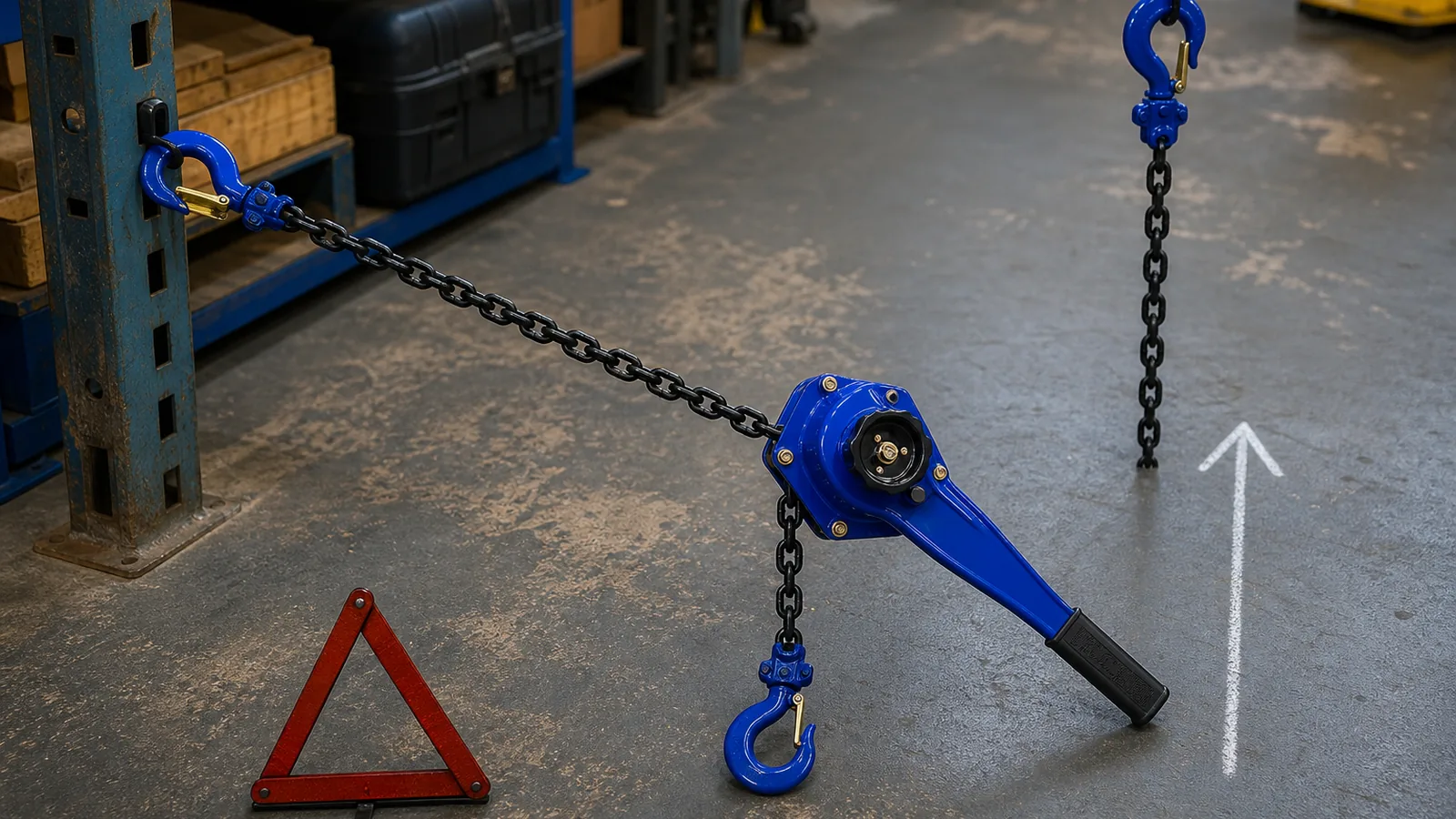
Common mistakes using lever hoist UK: UK Practical Guide
Common mistakes using lever hoist UK usually stem from skipping pre-use checks, overloading against the rating plate, poor anchorage or tip-over set-ups with a come-along, side-loading the chain, and continuing after abnormal noise, binding or damage. Used correctly, a lever hoist (ratchet lever hoist / chain hoist / come-along) can lift or pull heavy loads safely and efficiently; used carelessly, the same errors can cause accidents even for experienced operators.
Symptom → likely cause
Match what you see or hear to a likely cause before you force another lever stroke:
- Lever feels excessively hard or the unit will not ratchet freely — possible overload, twisted or kinked chain, wrong free/load mode, or a mechanical fault.
- Load drifts, slips or will not hold — incomplete engagement, worn brake/pawls, contaminated oil or dirt in the mechanism, or incorrect mode selection.
- Chain jumps, twists or rides unevenly — side-loading, reeving over a sharp edge, or a damaged/stretched link.
- Hook, frame or housing shows deformation or cracks — prior overload, shock loading or impact; stop and isolate.
- Come-along tip-over or unstable pull — anchorage not in line with the load, soft or inadequate fixing points, or using the hoist as a makeshift winch without a planned load path.
Industry guidance stresses that lever hoists are widely used for lifting and pulling, but even seasoned professionals make errors that lead to accidents when equipment is not employed as intended. Follow published safe-use steps covering inspections, operation and maintenance rather than improvising under pressure.
Safe stop criteria
Stop work immediately and secure the area if any of the following apply:
- The load feels heavier than expected or the lever effort rises sharply without a clear reason.
- You cannot confirm the working load from the rating plate (for a 0.75t-class unit, do not assume capacity beyond what the plate states).
- The chain, hooks, latches, lever or housing show damage, stretch, cracks, missing parts or abnormal wear.
- The hoist binds, slips, makes unusual noise, or will not hold the load.
- The anchorage, sling or load path is uncertain, out of line, or at risk of tip-over.
- Anyone is under or in the line of a suspended or tensioned load.
Hand-operated chain lever hoist safe-use documents issued for UK workplaces outline care and safe use expectations under health and safety duties; treat stop criteria as non-negotiable, not optional tips.
What competent users can check
Before each use, a competent person should complete a visual and functional check. A practical sequence includes:
- Confirm the identity and rating plate match the intended lift or pull; never guess capacity.
- Inspect hooks, safety latches, chain links, end stops, lever, selector and housing for wear, deformation, corrosion or missing parts.
- Check free/load (or equivalent) mode selection and that the ratchet engages and holds under light test tension before the full lift.
- Verify anchorage and load path are suitable, in line, and free from side-loading or sharp edges.
- Ensure the area is clear, the load is stable, and nobody will walk under the suspended or tensioned load.
- After use, store clean and dry; report defects rather than “working around” them.
Step-by-step lever chain hoist guidance typically covers inspections, operation tips, safety rules and maintenance — use those themes as your checklist baseline, and seek competent advice when anything is unclear.
When to remove from service
Remove the hoist from service and quarantine it for competent assessment if:
- Any load-bearing part is cracked, bent, stretched or incomplete.
- The brake or holding function is unreliable.
- The chain is twisted, gouged, elongated or does not seat correctly.
- Hooks are opened, latches missing or the throat shows measurable distortion.
- You suspect shock loading, overload or tip-over misuse.
Use confirmed details examination stickers, certificates or test numbers. Point decisions to the rating plate, manufacturer instructions and competent person advice. Do not claim statutory examination outcomes you cannot verify on the unit in front of you.
Next step / replacement path
If your current lever hoist fails checks, or you need a clear 0.75t / 6 m class ratchet lever hoist for warehouse, construction or automotive lifting and pulling with G80 steel chain, review the Manual Lift 0.75t 6M ratchet lever hoist product details and confirm the rating plate and suitability for your task before purchase or use.
FAQ
What are the most common mistakes using lever hoist UK sites should watch for?
Skipping pre-use inspection, ignoring the rating plate, side-loading the chain, poor anchorage or come-along tip-over set-ups, and continuing after slip, binding or damage are the patterns most often linked to incidents.
Can I rely on a ratchet lever hoist UK unit without reading the plate?
No. Capacity and configuration must come from the rating plate and instructions. For a 0.75t-class product, use confirmed details higher safe working loads or unverified performance claims.
Is a 0.75t 6m chain hoist suitable for every job?
Only if the rated capacity, lift length, anchorage and load path suit the task. Match the hoist to the job; if in doubt, stop and get competent advice rather than improvising.
Where can I read more on safe use?
Use reputable guidance on common lever-hoist mistakes, step-by-step safe operation, and published safe-use notes for hand-operated chain lever hoists — then apply those principles to your own equipment checks.